
Small businesses in Australia can claim an instant asset write-off up to $20,000 for eligible purchases. This valuable tax tip could substantially reduce your business’s taxable income.
The Australian Taxation Office’s (ATO) tax rules can be complex to navigate. The ATO has launched its 2025 Tax Time Toolkit to help business owners meet their tax obligations. Businesses must register for Goods and Services Tax (GST) when their annual turnover reaches $75,000 or more. This represents just one of many compliance requirements business owners need to manage.
Poor record-keeping and mixing personal expenses with business costs create problems for many small businesses. These errors often lead to serious ATO compliance issues. The tax office has reduced lodgment extensions this year, which makes proper tax planning crucial.
Let’s explore practical tax-saving strategies for your small business. We’ll help you maximize legitimate deductions and avoid common mistakes. Smart moves like prepaying next financial year’s expenses and maintaining proper documentation for all claims can help you retain more of your hard-earned money. Our straightforward advice covers everything you need to know.
Avoid the Most Costly Tax Mistakes
Tax mistakes can hit your small business hard. The ATO’s random checks on small businesses show that most try to report correctly, but errors happen often. Let’s get into the three costliest tax mistakes and what you can do about them.
Inaccurate or missing records
Good documentation is the foundation of tax compliance. Australian law says you need to keep all transaction records linked to tax, superannuation, and registration for 5 years. These records should clearly show key details of your transactions – dates, amounts, descriptions, and GST information.
Poor record-keeping leads to:
- Mistakes in tax returns that trigger ATO audits
- Lost legitimate deductions that cost you extra tax
- Fines starting at AUD 478.57 for each violation
- Cash flow problems and wrong business decisions
Using accounting software like Xero or MYOB can help you keep better records. Monthly bank reconciliations will also catch any gaps between your reported income and actual cash flow.
Mixing personal and business expenses
Small business owners often make the costly mistake of mixing personal and business finances. This makes tax reporting harder and you might lose valid deductions.
The difference between personal and business expenses should be crystal clear: if an expense helps earn business income, it’s business-related – everything else is personal. For things you use both ways (like laptops or vehicles), you can only claim the portion used for business.
Here’s how to keep things separate:
- Set up dedicated business bank accounts and credit cards
- Buy separate items where you can (one for work, one for personal)
- Log usage percentages for shared items
- Keep solid proof of business expenses
Clean separation gives you a better picture of your business finances and makes tax season much easier.
Forgetting to register for GST when required
Your business needs to register for GST once you hit AUD 114,674.27 in turnover. You have 21 days to register after reaching this amount. Taxi and ride-share services must register whatever their turnover.
Not following these rules can hurt:
- You’ll owe GST on sales from when you should have registered, even if customers didn’t pay it
- The ATO can charge penalties and interest
- Other businesses might not want to work with you
- Fines can reach 20 penalty units (each unit costs AUD 478.57)
Check your GST turnover monthly if you’re close to the threshold. Keep in mind that GST turnover means your total business income minus certain items like GST in sales and input-taxed sales.
The ATO understands honest mistakes happen. If you discover you should have registered earlier, contact them right away. They’ll work with you to fix things.
Understand What You Can and Can’t Claim
Tax deductions can make a huge difference to your business bottom line. You need to know what you can and can’t claim. The basic rule is simple – if you spend money to earn income, you can usually claim it. Many business owners miss out on legitimate claims or face ATO penalties because they claim incorrect deductions.
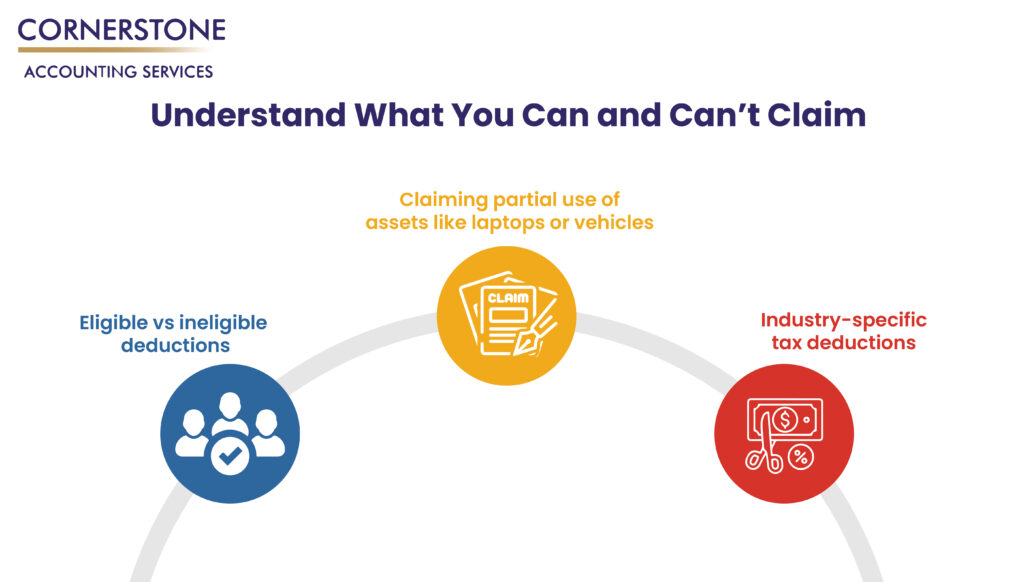
Eligible vs ineligible deductions
The ATO’s rule for business deductions is straightforward – expenses must directly link to your income. Here’s what you can typically claim:
- Operating expenses like rent, utilities, and insurance premiums
- Employee wages, super contributions, and contractor payments
- Marketing and advertising costs
- Professional development and industry memberships
- Work-related travel expenses
- Interest on business loans and bank fees
Some expenses you can’t claim include:
- Private or domestic expenses (like childcare or home mortgage)
- Entertainment costs (client lunches or sporting events)
- Traffic fines and penalties
- Income tax payments or GST amounts
- Expenses related to earning tax-free income
It’s worth mentioning that timing plays a crucial role. You can claim expenses in the year you incur them unless they’re capital expenses or fall under specific depreciation rules.
Claiming partial use of assets like laptops or vehicles
Assets used for both business and personal reasons need careful tracking. You can only claim the portion used for business, which means keeping accurate records.
Vehicle claims offer two main options:
- Logbook method – Track all trips for 12 weeks and calculate your business-use percentage based on business kilometers versus total distance.
- Cents-per-kilometer method – Claim 78 cents per kilometer for up to 5,000 business kilometers each year without detailed records.
For home offices and electronic devices:
- Work out business-use percentage with reasonable estimates and evidence
- Keep track of usage through diaries, calendars, or timesheets
- Get separate devices just for business when possible
The ATO often inspects these claims closely, so keep records of how you calculated your business-use percentages.
Industry-specific tax deductions
Each industry comes with its own set of deductible expenses beyond the basics:
Trades and construction:
- Tools and equipment under the instant asset write-off threshold
- Protective clothing and safety gear
- Vehicle expenses for traveling between job sites
- License renewals and industry certifications
Professional services:
- Professional indemnity insurance
- Continuing professional education
- Reference materials and subscriptions
- Home office expenses for client preparation work
Retail businesses:
- Point-of-sale systems and inventory management software
- Shop fittings and displays
- Merchant fees and payment processing costs
- Packaging materials and delivery expenses
Hospitality:
- Food handling certifications
- Specialized equipment and uniforms
- Food waste disposal costs
- Music licensing fees
Understanding expenses specific to your industry operations are the foundations of maximizing deductions. An accountant who knows your industry can help find legitimate claims you might miss. Detailed records of all industry-specific deductions are essential since the ATO pays extra attention to these during reviews.
Use Smart Tax Planning Strategies
Smart tax planning goes beyond knowing what you can claim. timing is everything. You can legally reduce your tax burden and keep healthy cash flow with the right approach. Here are three powerful ways to save money before the tax deadline arrives.
Prepay expenses before EOFY
Small businesses with combined turnover under AUD 76.45 million can benefit from prepaying expenses right away. This approach lets you claim deductions in the current financial year for expenses you pay ahead of time.
The ATO will fully deduct prepaid expenditure when:
- The service period is 12 months or less
- The service period ends before June 30, 2026 (for FY 2025 claims)
These common deductible prepayments are worth noting:
- Rent or lease payments
- Business insurance premiums
- Software or platform subscriptions
- Memberships or professional association dues
- Loan interest on eligible business borrowings
To cite an instance, see how a business with June 1 lease renewal could prepay 12 months’ rent and deduct the full amount in FY 2024–25. This brings forward deductions that would normally hit next year’s books.
Review your Chart of Accounts and supplier billing schedules by June 10 to make the most of this strategy. This gives you enough time to process payments before the financial year ends.
Delay income where appropriate
Pushing income reception past June 30 makes sense if you expect higher income this financial year compared to next.
Here’s how you can defer income:
- Wait until July to issue invoices (if your cash flow allows)
- Hold off accepting debtor or cash payments until the new financial year
This works especially well when you expect lower profits next year. Moving income to a period with lower earnings might help you qualify for a reduced tax rate.
Contribute to superannuation for tax benefits
Superannuation contributions are a great way to get tax benefits for small business owners. The concessional cap sits at AUD 45,869.71 per annum for FY24–25. This helps you reduce taxable income while building your retirement nest egg.
Remember these key points:
- Your super fund must receive contributions before June 30 to count for current year deductions
- Allow 3-5 days for payments to clear through your clearing house
- Super payments that arrive late won’t be deductible until next year
You might carry forward unused cap amounts from previous years if your total super balance was under AUD 764,495.12 on June 30, 2024. This gives you more flexibility in tax planning.
Making contributions to your spouse’s super can also provide tax offsets and create balanced retirement savings.
Professional advice can save you thousands in unnecessary tax. Adam at Cornerstone TAS offers no-obligation consultations for tax planning and strategies – head to book your meeting today.
Stay on Top of ATO Compliance
Missing tax deadlines can eat into your business profits through heavy penalties and interest charges. Business owners need a clear calendar of important dates and should understand the consequences of missing them.
Know your tax deadlines for 2025–2026
The Australian financial year runs from July 1 to June 30, with several crucial deadlines throughout this period. Here are the key dates for the 2025–2026 financial year:
October 31, 2025 is the standard deadline for self-lodged tax returns and businesses that have outstanding prior year returns. Businesses working with registered tax agents usually get extensions.
The quarterly BAS lodgement deadlines are:
- Quarter 1 (July-September): November 25, 2025 (if lodging via tax agent)
- Quarter 2 (October-December): February 28, 2026
- Quarter 3 (January-March): May 26, 2026
- Quarter 4 (April-June): August 25, 2026
Superannuation contributions must be paid within 28 days after each quarter ends. Starting July 1, 2026, employers must pay employee superannuation along with salary and wages.
Avoid penalties by lodging on time
The ATO charges Failure to Lodge (FTL) penalties at one penalty unit (AUD 504.57) for each 28-day period your lodgement is late, up to five penalty units.
Penalties increase based on business size:
- Medium entities (turnover between AUD 1.53 million and AUD 30.58 million) pay double penalties
- Large entities (turnover exceeding AUD 30.58 million) pay five times the standard penalty
The ATO also applies General Interest Charges (GIC) on unpaid tax debts at 10.78% per annum. Penalties rarely apply to one-off late lodgements or returns that result in refunds or nil balances.
Use ATO tools and checklists
The ATO’s small business toolkit offers several helpful resources:
The ATO app gives you quick access to tax tools and includes myDeductions to record business income and expenses in one place. ATO Tax inVoice podcasts keep you updated with the latest tax information.
Small business webinars cover topics from tax obligations to entitlements. The Small Business Newsroom delivers tax updates straight to your inbox.
The ATO’s due dates by topic tool helps you track obligations by specific categories. Small business standards let you compare your business performance with similar operations in your industry.
If you face financial difficulties, reach out to the ATO before the due date to discuss support options. Open communication helps you avoid unnecessary penalties and maintain good standing with tax authorities.
Get Professional Support and Plan Long-Term
Professional tax expertise can change your tax outcomes by a lot. A skilled accountant provides great ways to get benefits that go beyond simple tax compliance.
Benefits of hiring a small business tax accountant
Small business tax specialists know Australia’s complex and ever-changing tax laws inside out. They spot industry-specific deductions you might miss and ensure you meet ATO requirements. These experts do more than prepare taxes. They give you business advice about tax-efficient structures and help you plan for growth.
Business owners value their time savings the most. The hours you spend on tax work could be better used to grow your business. Studies show that professional help saves both money and time, even after accounting for the costs.
Use digital tools for tax optimization
Digital bookkeeping systems make tax obligations easier and offer many advantages. Cloud accounting solutions track your income, expenses, and assets. They calculate wages and tax amounts automatically and create summaries for GST and income tax reporting. Your financial data stays safe with cloud storage backup features that protect against disasters.
Sole traders can record their business income and expenses anywhere through the ATO app’s myDeductions tool. E-filing through these systems gets your refunds processed within 21 days, which helps your business’s cash flow by a lot.
Plan your business exit with tax in mind
Tax-smart exit planning is vital to maximize your business investment return. Poor tax planning can turn a good deal bad quickly. Early meetings with professional advisors help structure your eventual sale in a tax-efficient way.
Small business CGT concessions can reshape the tax picture for smaller businesses. Under specific conditions, you could sell a business worth AUD 6.12 million without paying any tax.
Adam at Cornerstone TAS offers no-obligation consultations for tax planning and strategies.
Conclusion
Effective tax management for your small business can substantially affect your bottom line. This piece explores practical strategies that help you navigate Australia’s tax system while keeping more of your hard-earned money.
Sound tax management starts with avoiding mistakes that can get pricey. Your business needs accurate records, separate personal and business expenses, and GST registration when required to prevent penalties and stress.
The right deduction claims make a real difference to your tax position. Note that you can generally claim expenses directly tied to earning your income as deductions, though assets with partial use need proper documentation.
Your business should focus on smart tax planning strategies before the financial year ends. You can legally reduce your tax burden by prepaying expenses, delaying income where suitable, and making strategic superannuation contributions.
Your business must prioritize ATO compliance deadlines. Large businesses face steeper penalties for missed lodgment dates.
Professional support provides value beyond simple compliance. A qualified accountant identifies industry-specific deductions and saves your precious time. Digital tools make the process smoother and less burdensome.
Tax planning extends beyond the current financial year, it shapes your long-term business experience. Smart tax strategies protect your wealth and maximize your business investment, whether you’re new to business or planning an exit.
Connect with a tax professional today to reshape your business taxation approach. The money saved through proper tax planning belongs to you, you just need to hold onto it.
Key Takeaways
Master these essential tax strategies to legally reduce your small business tax burden and avoid costly compliance mistakes in Australia.
• Keep accurate business records for 5 years and separate personal expenses to avoid ATO penalties starting at $478.57 per violation
• Register for GST within 21 days once turnover reaches $75,000 to prevent paying uncollected GST plus penalties
• Prepay eligible expenses before June 30 and delay income to the next financial year for immediate tax savings
• Claim only business-use portions of shared assets like vehicles using the logbook method or 78 cents per kilometer
• Meet critical deadlines: October 31 for tax returns, quarterly BAS dates, and super contributions within 28 days
• Consider professional tax advice to identify industry-specific deductions and long-term exit planning strategies
Strategic tax planning isn’t just about compliance. It’s about maximizing your business profitability through legitimate deductions and proper timing of income and expenses.
FAQs:
Key deductions include operating expenses like rent and utilities, employee wages, marketing costs, work-related travel, and interest on business loans. Remember to only claim expenses directly related to earning your business income and keep accurate records for all deductions.
Open separate business bank accounts and credit cards, purchase duplicate items for business and personal use when possible, track usage percentages for shared assets, and maintain clear documentation supporting the business portion of expenses. This separation helps with tax compliance and provides clearer visibility into your business’s financial health.
You must register for GST within 21 days of your business reaching an annual turnover of $75,000 or more. For taxi or ride-sharing services, registration is mandatory regardless of turnover. Failing to register when required can result in penalties and having to pay GST on sales made since you were required to register.
Consider prepaying expenses before the end of the financial year, delaying income where appropriate, and making strategic superannuation contributions. These strategies can help reduce your taxable income while maintaining a healthy cash flow. Always consult with a tax professional to ensure these strategies align with your specific business situation.
A qualified small business tax accountant can help identify industry-specific deductions, ensure compliance with ATO requirements, provide strategic advice on business structuring, and assist with long-term planning. They can save you time and potentially money by navigating complex tax laws and optimizing your tax position.